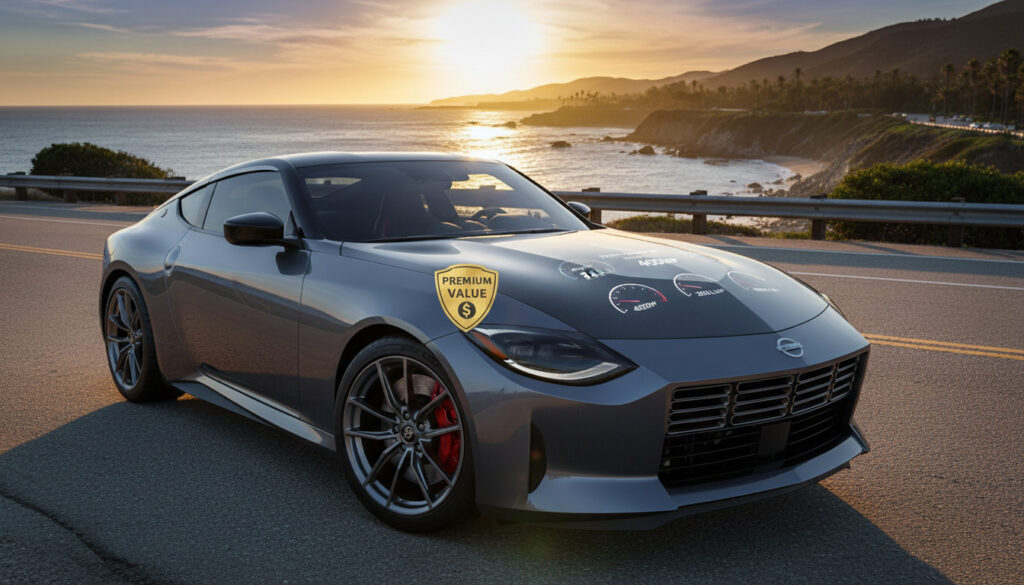
日産・フェアレディZ RZ34 – スペック性能価格を詳しく解説
Grid
The RZ34 consolidates performance metrics into a compelling value proposition. Power originates from a twin-turbocharged 3.0-liter V6 VR30DDTT generating 400 horsepower and 350 lb-ft of torque, channeled through either a close-ratio six-speed manual or a paddle-shifted nine-speed automatic. Acceleration to 60 mph requires approximately 4.3 seconds, with top speed electronically limited to 155 mph on standard configurations.
Key dimensions reflect discipline: 4,381 mm overall length, 1,849 mm width, and a 2,550 mm wheelbase carried over from the previous generation yet structurally reinforced. Curb weight starts at 1,582 kg for manual-equipped models. The launch allocation included 240 units of the Proto Spec edition, featuring exclusive bronze Rays wheels, yellow brake calipers, and two-tone leather upholstery.
Insights
The VR30DDTT architecture represents a significant departure from the naturally aspirated VQ series, introducing water-cooled intercoolers integrated into the intake manifold for thermal efficiency. Turbocharger positioning directly atop the exhaust manifolds reduces lag to negligible levels below 2,000 RPM, while dual fuel injectors per cylinder—port and direct—optimize combustion across the rev range. Engineering documentation indicates that internal components, including the sodium-filled exhaust valves, derive from motorsport applications.
Chassis development focused on torsional rigidity rather than weight reduction alone. Stiffening panels added to the rear bulkhead and strut towers increase lateral rigidity by 10.8 percent compared to the 370Z platform. The front double wishbone suspension retains aluminum lower control arms, though bushing compounds have been reformulated for reduced deflection under cornering loads.
Table
| Specification | Fairlady Z Version S (6MT) | Fairlady Z Version ST (9AT) | Proto Spec Limited |
|---|---|---|---|
| Engine | VR30DDTT V6 Twin-Turbo | VR30DDTT V6 Twin-Turbo | VR30DDTT V6 Twin-Turbo |
| Power Output | 405 PS @ 6,400 rpm | 405 PS @ 6,400 rpm | 405 PS @ 6,400 rpm |
| Torque | 475 Nm @ 1,600–5,600 rpm | 475 Nm @ 1,600–5,600 rpm | 475 Nm @ 1,600–5,600 rpm |
| Differential | Mechanical LSD | Mechanical LSD | Mechanical LSD |
| Wheels | 19″ Rays forged alloy | 19″ Rays forged alloy | 19″ Bronze Rays forged |
| Production Volume | Unlimited | Unlimited | 240 units (Japan) |
Performance testing documented by Car and Driver indicates the automatic transmission achieves marginally quicker acceleration figures, though the manual gearbox retains preference among enthusiast demographics for its mechanical directness and standard SynchroRev Match system.
Details
Exterior design synthesizes heritage cues through modern execution. The rectangular grille opening references the 300ZX (Z32) while the elongated hood and cabin-fastback silhouette echo the original 240Z (S30). LED headlight assemblies incorporate distinctive “Z” signatures in their daytime running light patterns. At the rear, a full-width light bar integrates turn signals and brake illumination, bracketed by vertical elements suggesting the 300ZX tail lamp architecture.
Interior architecture departs from the 370Z’s austere layout through adoption of a 12.3-inch fully digital instrument cluster offering three distinct display modes. The center stack retains three analog pod gauges—boost pressure, turbo speed, and battery voltage—positioned atop the dashboard in tribute to 1970s Z configurations. Interior assessments highlight the improvement in material quality, including synthetic suede door panels and contrast-stitched leather shift boots, though storage space remains limited to a single cupholder and shallow door pockets.
Timeline
Development commenced publicly during the 2018 Tokyo Auto Salon, where Nissan design chief Alfonso Albaisa confirmed active work on a successor to the 370Z. The Z Proto concept emerged in September 2020 through a digital reveal, showcasing 80 percent of the eventual production design. Pre-production testing utilized modified 370Z bodies (mules) captured at the Nürburgring throughout 2019 and 2020.
August 17, 2021, marked the global production reveal simultaneously in New York and Yokohama. Japanese domestic market sales initiated January 2022 through a lottery system for early allocation, with North American deliveries commencing June 2022. European markets received the model in limited numbers during third-quarter 2022, though right-hand-drive UK specifications were discontinued citing regulatory complications.
Clarity
Platform architecture generates frequent misconception regarding its relationship to the Infiniti Q60. While both vehicles share basic structural hardpoints and the VR30DDTT engine block, the RZ34 utilizes unique suspension kinematics, bespoke tuning for the electric power steering, and Z-specific body panels. Nissan technical documentation confirms that no exterior panel interchange exists between the Fairlady Z and Q60.
The “RZ34” chassis code follows Nissan’s internal nomenclature convention: R designates rear-wheel-drive sports platforms, Z indicates the model line, and 34 signifies the fourth generation under this coding system (following Z33 and Z34). Manual transmission availability varies by market; Japanese buyers may specify the six-speed across all trim levels, whereas certain export markets restrict the manual to Performance-grade specifications only.
Analysis
Market positioning places the RZ34 between the Toyota GR Supra and entry-level European roadsters. Priced substantially below the Porsche 718 Cayman, the Z targets buyers prioritizing analog engagement over electronic assistance abundance. The hydraulic steering rack—retained despite industry trends toward full-electric systems—delivers granular feedback regarding front tire grip thresholds.
Dynamic behavior favors controllable oversteer through corner exits, facilitated by the mechanical limited-slip differential’s 35-percent lockup under acceleration. Ride quality compromises inherent to the short wheelbase and rigid chassis tuning accept the trade-off for reduced body roll during transient maneuvers. Comparative testing against the GT-R R35 highlights the Z’s preference for driver-adjustability over all-wheel-drive grip, requiring deliberate throttle modulation to exploit the rear-biased weight distribution.
Quotes
“The Z is the pure expression of joy. We wanted the car to smile, to be approachable yet aggressive. It respects the past without being复古—it lives in the now while honoring where it came from.” 日産フェアレディZ RZ34は、ツインターボ3.0L V6 VR30DDTTエンジンを搭載し、最高出力400馬力、最大トルク350lb-ftを発揮し、詳細についてはリットリンク競図情報をご覧ください。
Alfonso Albaisa, Senior Vice President, Nissan Global Design
“Four hundred horsepower sounds like a number, but the Z is never about numbers. It is about the connection between the driver’s right foot and the rear tires. We kept the manual transmission not because it is faster, but because it is more human.”
Hiroshi Tamura, Chief Product Specialist, Nissan Z
Summary
The Fairlady Z RZ34 delivers turbocharged performance through a chassis retaining hydraulic steering fidelity and manual transmission availability—increasingly rare commodities among contemporary sports cars. By evolution rather than revolution of the Z34 platform, Nissan has minimized development costs while maximizing the driving engagement quotient. The synthesis of 1970s design DNA with 2020s forced-induction power creates a distinct market proposition for enthusiasts rejecting digital filtration of the driving experience.
FAQ
What distinguishes the RZ34 from the previous 370Z?
The RZ34 replaces the naturally aspirated 3.7-liter VQ37VHR with a twin-turbo 3.0-liter VR30DDTT, increasing power from 332 to 400 horsepower. Structural rigidity improvements, updated suspension geometry, and a completely revised exterior and interior design differentiate it, despite sharing the 2,550mm wheelbase.
Is the manual transmission available globally?
Six-speed manual availability varies by trim and region. Japanese markets offer the manual transmission across all grades, while North American availability restricts the manual to Performance and Proto Spec trims. Australian and European markets receive the automatic transmission exclusively in certain specifications.
Why does the Japanese model use “Fairlady Z” instead of “Nissan Z”?
“Fairlady” has designated Nissan’s sports car lineup domestically since the 1960s S210 chassis. Export markets adopted the “Z” nomenclature for simplicity, but Japan retains the historical nameplate. Mechanically, domestic and export variants remain identical aside from instrument cluster calibration and radio frequencies.
Does the RZ34 use the same platform as the Infiniti Q60?
While both vehicles share the FM (Front Midship) platform architecture and VR30DDTT engine block, the RZ34 features unique suspension kinematics, bespoke body panels with no interchangeability, and Z-specific steering calibration. The Q60 emphasizes grand-touring comfort, whereas the Z targets track-capable stiffness.
What is the significance of the Proto Spec edition?
Limited to 240 units in Japan and 1,000 units in North America, the Proto Spec references the 2020 Z Proto concept through exclusive Ikazuchi Yellow paint, bronze Rays 19-inch forged wheels, yellow brake calipers, and two-tone leather seats with yellow accents. It represents a cosmetic package rather than performance enhancement.
How does the SynchroRev Match system function?
Standard on manual transmission models, this system automatically blips the throttle during downshifts to synchronize engine and transmission speeds, eliminating the need for heel-toe technique. A dashboard button allows deactivation for drivers preferring conventional pedal operation.
関連記事をさらに表示
 ニューヨーク屋敷のプロフィール・大学・結婚・年収を解説
 石田組 コンサート 予定 2025 完全ガイド ツアー日程一覧からチケット入手方法、鑑賞マナーまで解説
 デキストロメトルファンは喉の痛みに効く?効果・使い方・注意点・メジコン市販薬・カロナール比較を解説
 堂本光一と佐藤めぐみ結婚はいつ?交際10年と引退の真相
 バイエルン 対 RBライプツィヒ スタメン発表!DFBポカール&ブンデスリーガ比較
 横浜から下田のロイヤルエクスプレス料金|25,000〜40,000円食事付き日帰り・1泊2日プラン比較
 千葉の10日間天気予報は気象庁どこで見る?ウェザーニュース・tenki.jp比較と雨雲レーダー活用法
 オクニョの簡単なあらすじと実在人物の真実
